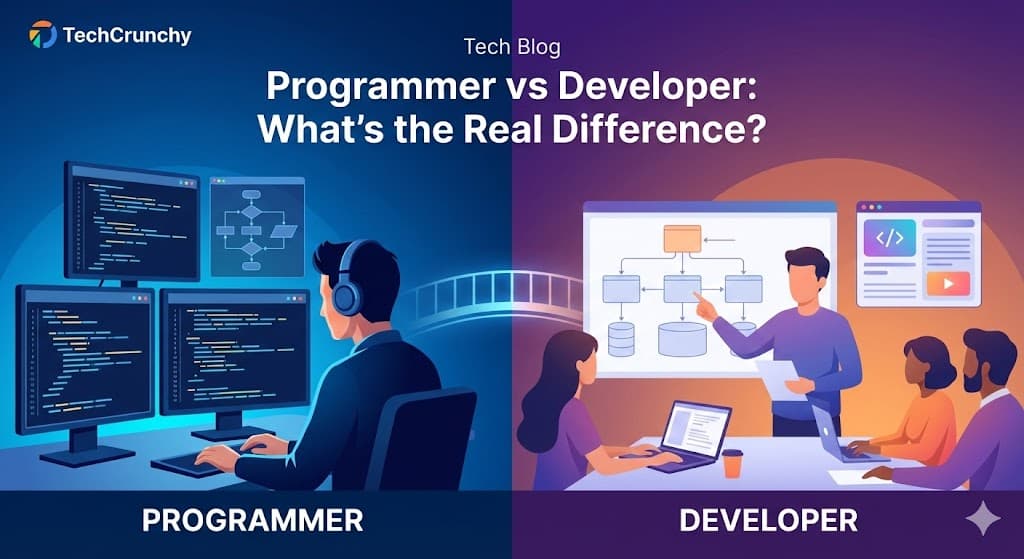
While it is true that both roles involve writing code to create software, stopping at that definition is like saying a line cook and an executive chef do the exact same job because they both work in a kitchen. In the tech industry, the distinction between a programmer and a developer is significant. It dictates their daily responsibilities, the scope of their projects, the skills they need, and their overall career trajectory.
In this comprehensive guide by TechCrunchy, we are going to dive deep into the "Programmer vs Developer" debate. We will break down what each role actually entails, highlight the key differences, and help you understand which path (or which hire) is right for your needs.
Who is a Programmer?
A programmer is a highly skilled technician of the coding world. Their primary responsibility is to take a set of instructions, logic, or a specific design and translate it into a language that a computer can understand.
Think of a programmer as an expert translator. They are given a blueprint of what a piece of software should do, and their job is to write the clean, efficient, and error-free code to make it happen. They are typically masters of one or more programming languages, such as Python, Java, C++, or JavaScript.
Key Responsibilities of a Programmer:
- Writing Code: This is the core of their job. They write the actual lines of code based on provided specifications.
- Debugging: Programmers spend a significant amount of time finding and fixing errors (bugs) in their code or code written by others.
- Testing Code: Running unit tests to ensure that the specific block of code they just wrote performs its intended function without failing.
- Algorithm Implementation: Taking complex mathematical or logical algorithms and turning them into functional code.
Programmers are incredibly detail-oriented. They focus heavily on the "how"—how to make this specific function work as fast and as cleanly as possible. However, they usually do not design the overall system or worry about how their specific piece of code interacts with a massive, multi-tiered application architecture.
Who is a Developer?
If a programmer is the technician, a developer is the project manager and architect rolled into one (while still retaining the coding skills of the technician). A developer’s role encompasses the entire Software Development Life Cycle (SDLC).
Developers don't just write code; they build software solutions. They are involved from the initial concept and design phases all the way through to deployment and ongoing maintenance. While they spend plenty of time writing code, they also spend a massive chunk of their time planning, communicating, and problem-solving on a macro level.
Key Responsibilities of a Developer:
- System Design and Architecture: Planning how different components of a software application will interact with each other.
- Writing Code: Like programmers, they write code, but often with a focus on how it integrates into the larger system.
- Project Management: Overseeing timelines, defining project scopes, and ensuring milestones are met.
- Client/Stakeholder Communication: Gathering requirements from clients or management and translating those business needs into technical specifications.
- Testing and Quality Assurance: Overseeing comprehensive testing of the entire application (integration testing, user acceptance testing), not just individual lines of code.
- Deployment and Maintenance: Pushing the software live and handling updates, scaling, and long-term bug fixes.
Developers need to understand the big picture. They are problem solvers who use code as just one of the many tools in their toolbelt to create a fully functional, user-friendly product.
Programmer vs Developer: The Core Differences
To make it incredibly clear, let’s break down the differences across several key categories:
1. Scope of Work
- Programmer: Narrow scope. Focused entirely on writing and testing specific blocks of code. They are given a problem and they code the solution.
- Developer: Broad scope. Involved in the entire lifecycle of the software, from brainstorming the initial idea to maintaining it years after launch.
2. Skill Sets
- Programmer: Deep technical knowledge of specific programming languages (syntax, libraries, and frameworks). Excellent algorithmic thinking.
- Developer: Broad technical knowledge (languages, frameworks, database management, server architecture) combined with strong soft skills. They need excellent communication, leadership, and project management abilities.
3. Approach to Problem Solving
- Programmer: Solves micro-level problems. “How do I write a function that sorts this array in under 2 milliseconds?”
- Developer: Solves macro-level problems. “How do we build an application that can handle 10,000 concurrent users while maintaining data security and providing a seamless user experience?”
4. Interaction and Collaboration
- Programmer: Often works in isolation. They receive a task from a lead developer or project manager, put on their headphones, and code.
- Developer: Highly collaborative. They constantly interact with clients to understand needs, UI/UX designers for interfaces, QA testers for bugs, and programmers to delegate coding tasks.
A Quick Comparison Table
| Feature | Programmer | Developer |
|---|---|---|
| Primary Focus | Writing code, syntax, algorithms | Building complete software solutions |
| Project Involvement | Execution phase (coding) | Entire Software Development Life Cycle |
| Scope of View | Micro (Specific functions) | Macro (Overall architecture) |
| Key Skills | Specific languages, debugging | Languages, architecture, communication, project management |
| Client Interaction | Rare | Frequent |
What About Software Engineers?
Just when you thought you had it figured out, the term "Software Engineer" enters the chat. How does this fit in?
Think of a Software Engineer as a developer who applies strict engineering principles to software creation. They often deal with highly complex, large-scale systems (like operating systems or massive network architectures).
- Programmer: Builds the bricks.
- Developer: Designs and builds the house.
- Software Engineer: Designs and builds the entire city grid, ensuring the plumbing, electricity, and roads all work together perfectly.
Career Paths and Salary Expectations
Because the role of a developer requires a broader skill set and carries more responsibility, it generally commands a higher salary than a strictly programming role.
Many tech professionals start their careers as programmers or junior developers, focusing heavily on honing their coding skills. As they gain experience, learn how to manage databases, understand UI/UX principles, and get comfortable talking to stakeholders, they naturally transition into full-fledged Developer or Senior Developer roles.
- Average Programmer Salary: While highly dependent on location and the specific language they know, programmers earn a respectable income, often starting in the mid-range of tech salaries.
- Average Developer Salary: Developers, particularly Full-Stack Developers or specialized developers (like Blockchain or AI developers), often see a 15% to 30% increase in average salary compared to standard programming roles due to the added management and architectural responsibilities.
Which Path Should You Choose?
If you are just starting your tech journey, don't get too bogged down by the titles. The first step for both paths is exactly the same: Learn to code.
If you love the pure logic of coding, enjoy working independently, and find satisfaction in solving complex mathematical or algorithmic puzzles without wanting to deal with client meetings or overall project management, focusing purely on becoming an elite Programmer might be your calling.
However, if you are a "big picture" thinker, enjoy working in teams, want to understand how different technologies connect to create a final product, and have a knack for turning a raw idea into a profitable business solution, you should aim to become a Developer.
Conclusion
At TechCrunchy, we know that building a successful digital product requires both deep technical expertise and broad strategic vision. While "programmer" and "developer" are often used as synonyms in casual conversation, understanding the distinction is vital.
Programmers are the essential foundation; they write the intricate code that makes technology run. Developers are the architects and builders who use that code to construct the software that changes the way we live and work. Whether you are choosing a career path or looking to hire for your next big project, knowing exactly what each role brings to the table is the key to your success in the tech industry.